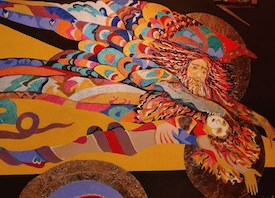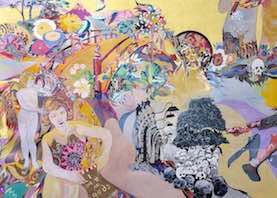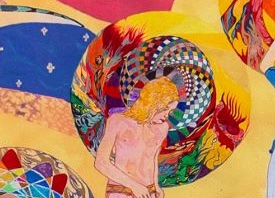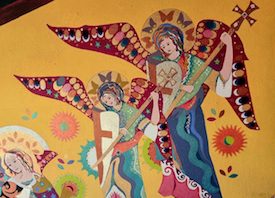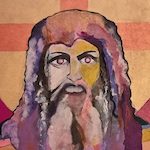
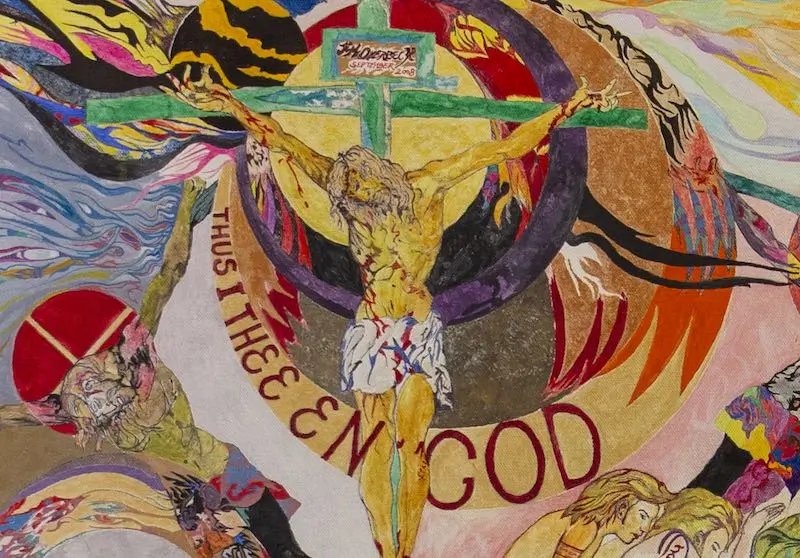
Theosis means becoming a god, becoming divine.
Given the human condition, it might seem outrageous to claim that it is possible to become a god; isn’t it presumptuous or even arrogant to assert that man could become divine?
However, according to Christ, this is our true nature. To approach God and commune with him, we must be transformed to become more like Him.
The experience of Theosis is to enter into a state of innocence and become a bearer of light.

We cannot achieve this transformation by ourselves; it is only through love and by the grace of God that this is possible, and – as He says – “seek and ye shall find”.
He, the indestructible and invincible God, calls us to his side, to His protection, to be His gods and to be transformed in Theosis. This is your duty and fulfilment to be a god; a god in the Kingdom of Christ.
In this ‘Way’, you will not die; in this ‘Truth’, you will be transformed; in this ‘Life’, you become a god.
The word ‘Theosis’, which comes from Greek, and its Latin equivalent ‘Deification’, may both seem remote from everyday speech, and that might lead you to think that the concept is of little importance.
However, quite the opposite is true – this idea is the most important of all ideas and central to Christ’s teaching. He urges us to become more like Him; this transformation, this Theosis, is what Christ Himself wants for us.
Read a detailed explanation of theosis.
This website is based on the life and work of Jim Overbeck
Find out more about Jim Overbeck. Christian visionary, writer, artist and mathematician.
Quote of the Day
"Incomplete (human) logic cannot know complete and perfect (human) logic. Like knows like: similia similibus percipientur."
The above quotes are taken from the work “Cogitatio”, which consists of 406 propositions concerning theology, maths and philosophy.
View Cogitatio (pdf 854kb)
Latest Article
- Jim’s Non-Cantorian Set Theory
 Jim Overbeck’s work on transfinitudes overthrows ideas of identity Jim Overbeck’s mathematics is a radical, non-traditional system that bridges set theory, mystical theology, and logic. A self-taught polymath described as a “super-genius” by British Military Intelligence, his work primarily centers on a spiritualized interpretation of the infinite known as Non-Cantorian set theory. Several Core Concepts … Read more
The Amazing World of Jim Overbeck
“Awake, O sleeper and rise from the dead …”
Jim’s Art Gallery
Galleria Arte del Fulmine (“Art of the Thunderbolt”) is an art gallery in Dolcedo, Italy, containing many paintings by visionary artist Jim Overbeck.
Theosis FAQs
-
Do people mention Theosis in church?
Most people would probably expect the church to teach the whole truth, but Theosis is never mentioned, at least in the Western Church – so it’s entirely valid to ask why.
Christianity diverged gradually between the 4th and 10th centuries. Due to theological [and philosophical] error, the mystical side of Christianity was almost entirely lost in the Western (Roman Catholic) Church, which later spawned Protestantism and the sects which diverged again from this. In the Eastern Church (Orthodoxy), the concept was retained by the theologians but is still rarely discussed and attempted. More details on this can be found in the Mystical Theology section.
That still doesn’t answer the question “why?”. Biblical references to the gods are glossed over in church and never explored. The early theologians are never discussed; theology is deemed to be something for the erudite, the bookworm, and the educated – purely academic; in other words, the only thing required is belief. (That of itself is dangerous – belief in what? You might ask). But true theology is about union with God, and it is an experience.
So, you have to conclude that the established church actually stands in the way of deification. It encourages people to make do with less, to focus on sin and salvation, on worship and ritual. Marx famously said that religion was the opiate of the masses – and to that extent, he was right. Religion is often a way of staying down, a form of enslavement. In other words, it can actually keep us from God. Christ himself, whilst fulfilling the Hebrew scriptures, was scathing towards the religious authorities of the time. He saw through the hypocrisy of the scribes and Pharisees (i.e. the local legal experts who followed rules from their forefathers rather than the Bible), who liked the appearance of holiness but reacted strongly against the actual presence of God Almighty on earth, the very thing (person) they were supposed to be seeking.
On that basis, the reason that Theosis is not mentioned in church would have to be that someone somewhere doesn’t want it mentioned. Now that’s a thought.
Identity is not your geographical location, but more about your relation to the Logos.
-
Do you have to be a monk to experience Theosis?
One of the things that puzzles me is, how can you learn theosis? Most people I imagine would think that you start by enrolling at some sort of college.
The simple fact is that God Almighty, creator of Heaven and Earth and all of us, can choose whomsoever he wants to enter his presence. On the one hand, those who earnestly seek Him are indeed more likely to find Him, but from time to time, He reaches out to the most unexpected people.
When Paul was on the road to Damascus, this great persecutor of the early Christians was given a revelation so intense that he was blinded for a while. God clearly saw something genuine in Paul that made him the right man for the job of taking the gospel to the Gentiles, which is what he then did. Paul was admittedly barking up the wrong tree when he started out, but he certainly made up for it later.
As Bob Marley put it – “There is one question I’d really like to ask: Is there a place for the hopeless sinner, who has hurt all mankind?”
Monks & nuns dedicate their lives to God – some perhaps do so for other reasons than to seek actual union with Him, while others may genuinely love Him. Christ makes it really clear that he came not to save the righteous but to save sinners. Until you check it out, you can’t possibly know what your divine nature could turn out to be. We’re all in this world, and we have responsibilities and ties, but we can find God in the stillness of the night or in the beauty of a flower and, of course, He can find us. It may not be necessary to take to the desert for decades, He does actually want us to get to know Him.
Identity is not your geographical location; it is more about your relationship to the logos.
-
Did Jesus ever say anything about Theosis?
I have read the bible, and I don’t remember him mentioning theosis, let alone saying anything in Greek. So what’s going on here?
Actually, he did. He quotes a Psalm in reply to a question, stating, “I say ye are gods”. Clearly, for most of the time, we do not appear to be gods but gods in rebellion, denying the power of the most high and denying our true nature. This is what Jim Overbeck means when he talks about it being possible to be simultaneously one thing and its opposite (see the section on Tertium Exclusi in Jim on Maths and Logic).
-
Is Theosis the same as sanctification?
Theosis and sanctification are closely related terms, but they don’t mean quite the same thing. Sanctification essentially means the process of being made holy through the actions of the Holy Spirit.
Almost every definition you will find of sanctification stops short of union with God; such definitions speak of assuming attributes, becoming a bit like God, as it were, but full participation in the divine nature is not considered. The concept is used freely in Catholic and Protestant theology, but although Orthodoxy recognises certain saints, it does not make use of the term sanctification.
The Orthodox have a formula: Purification -> Illumination -> Deification (Theosis). While one might equate purification with sanctification, remember that it is possible to experience Deification without a lengthy process of purification. If God wills it, He can make clean. Compare Isaiah - who asserted that he couldn’t do what was asked of him because he was a man of unclean lips - then his lips were touched by a burning coal, and he was made clean.
We are sinners, but Christ wills us to join Him and share the riches of His kingdom. He knows that we are frail, that we slip up, and do so repeatedly. Purification (moral or physical) is the process of fighting against this; illumination is the first fruits of our reward from God and a manifestation of the god within; deification is the fullness of that realisation.
-
Is there Theosis in Roman Catholicism?
Roman Catholicism does not dispute Theosis but emphasizes sanctification together with participation in the Life of God. They stress the importance of the sacraments, e.g. baptism, as an integral part of this.
No mention of Theosis is made in the Catechism of the Catholic Church. Here are some statements from the third section, “Life in Christ”, which include Biblical quotations:
- By the sacraments of rebirth, Christians have become children of God, “partakers of the divine nature”
- Christians can strive to be imitators of God as beloved children
- “sanctified . . . (and) called to be saints”,Christians have become the temple of the Holy Spirit
- The Holy Spirit renews us interiorly through a spiritual transformation.
These statements all fall short of actual Theosis, union with God in Christ, although some of them may imply it. By contrast, some individual Roman Catholic writers do talk of becoming divine or becoming gods; so for example, Padre Pio, venerated as a saint by the Catholic church, wrote, “Sanctifying Grace impresses the image of God upon us in such a way that we ourselves become divine by participation”. Father Juan Arintero, of a Catholic mendicant order, wrote, “He [the Holy Ghost] renews, transforms and deifies us, making us one with Jesus Christ our Saviour... He is the deifying God, we are deified gods”.
Some Catholic writers believe it is only our soul which is deified, whereas Eastern Orthodox Fathers make it clear that it is our whole being, including body and soul, which is deified. So for example, the Franciscan Father Juan de Los Angeles wrote, “The soul is made to participate with God Himself through a divine infiltration... It is wholly divinised or deified and has the appearance of God”. By contrast, the Orthodox St Symeon the New Theologian wrote: “Man is united to God spiritually and corporeally, for his soul is in no way separated from the spirit, nor the body from the soul.” Symeon makes clear the whole of us is deified, body too: “God enters into union with the whole man”.
-
What do Protestants think about Theosis?
Protestants do not usually talk or think about theosis. Instead, they use the word "salvation" to denote the process of being saved from out of the world.
The Church of England website doesn't mention theosis but proclaims that Protestants believe "God is available to us through the Holy Spirit". This implies that they believe a person may somehow encounter the Holy Spirit but it makes no mention of the transformation needed for a mortal to experience direct communion with God.
It would seem that most Protestants do not believe it is possible for a man to become transformed, transfigured, or deified, despite this having happened to St. Paul, who said, "I have been crucified with Christ and I no longer live, but Christ lives in me." (Galatians 2:20)
Many Protestants would have difficulty with the idea of "becoming a god in Christ", instead preferring to use language such as "being blessed", or "sonship". This is in spite of Jesus saying, "I have said ye are gods…" (Psalm 86:2 and John 10:34)
However, there is some variation amongst Protestants, with some holding fast to the idea of salvation, whereas others, notably those who lean towards the Anglo-Catholic tradition, are more open to some idea of theosis.