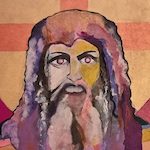
Like Christ before him Jim Overbeck was vilified, slandered and mocked. Why? Because all earthly empires outlaw the unfolding of Christs essential gift, the process of engodding or deification. Overbeck was a true theologian who participated in the power of Christ to shatter worldly and human appearance. He brought light to the world. A world defined by living death.

Psalm 82 “I have said, Ye are gods; and all of you are children of the most High.” Satan – the evil one and his hordes of demons – fear any such realisation and oppose deification with all evil force. Hence, they oppose Overbeck’s quest. At present Overbeck and his equally gifted wife attempt to reach humans by artistic means, having produced a vast output over the past decade, revolutionising the art form, painting with Christ’s rays. His tremendous scholastic work, The Autobiography Of God Almighty is where you will find evidence of polymath erudition, was still born, but the review below outlines its essential themes.
I used to run, in my younger days, past a small church in Harborne, Birmingham. In the stone lintel above the doorway of that church were cast these wise but exhorting words “In all things Love (St Paul)”. It is this commanded way of being that The Autobiography of God Almighty addresses. It is a book written under the personal tuition of God Almighty himself. The humanly named author Jim Overbeck describes himself as God’s (at times reluctant) scribe, as Christ genius on earth. It is in large part an explication of a central ontological theme i.e. that the essential mystery of Christ is the gift of deification. All risen humans were originally created from “shuddering zero” by the grace and bounteousness of God Almighty. Deification (being god, but not God Almighty, who is without equal) is possible for any “human”, as it was and will be in risen eternity. The only passport to true godhead on earth is the being of Christ. The being of Christ is mysteriously crowned by an “inner gentleness” and the absolute power of innocence. Through Christ Almighty, heaven, the ultimate reality is munificently ruled. The Almighty and his Heaven, therefore, are accessible now through co-option with Christ. The glories of the Almighty are not realised by sterile, abstract theology, ecclesiastical pose, obscure mysticism, hypothesis, or blind belief seeking confirmation after physical demise. God only requires a loving heart and heartfelt prayer to gain direct, personal, and face-to-face access to his glory before death.
I first met Overbeck while a graduate student at Durham in 1974. The divine viewpoint expressed in the book and the encyclopaedic learning in philosophy and theology that it evidences were already completed by Overbeck at the age of 29, when he had come to Durham University as a mature, undergraduate student in the department of theology. Needless to say, he met stiff opposition from Christ’s opponents, some of who were comfortably installed as princes of divine nowhere in the cloisters of the philosophy and theology departments. He had already written a long paper entitled “Deification Ontologies” an erudite, penetrating, ruthless, uncompromising, subversive and beautifully challenging piece of work. No mere human penned this brilliant script. Considered by the honest and receptive few to be an astonishing genius he was nevertheless labelled by the majority as a maverick, insane, delusional, inspired by the devil – just as his master before him Christ was. Eventually Overbeck turned his back on academia, and pursued his Christian life elsewhere. For Overbeck a theologian is a being with the power to introduce the fallen, the spiritually asleep, into the dimensions of heaven. During his time at Durham and thereafter, he inducted dozens of souls into the ultimate reality of heaven. If a being cannot do this, then he or she is not one of Christ’s theologians. Theology is nothing, a divine fetter; unless it shows itself forth in Christ’s living, divine power. I had made to approach two vicars, who were strolling down Church Street only to find that with a twirl of their umbrellas and a scuff of their shiny oxford black shoes, they had scurried furtively to the other side of the road. It was such divine imposters that presumed to judge Overbeck, negatively, and pour scorn on his claim to have seen Christ. Overbeck did not therefore have much time for the holy pose of the theology department or the arid souls that skunked around the philosophy department.
Almost beyond belief, the response to the shockingly brilliant “The Autobiography Of God Almighty”, written in devastatingly powerful style, has been virtually mute or entirely negative. This adamantine refusal to engage with the intellectual assault, the warmth of Christ’s logic, the claims and experiences documented in the book, are pre-figured in the author’s depiction of the worldwide divine conspiracy. This is a conspiracy whereby the fleshly manifestation as the human form denies the indwelling god. To do so is to be “sub human”. It is the indwelling god that is the source of the denial, hiding itself from its true identity, manifesting as the “human mutant”, against the light of Christ. This denunciation is the depth of a “self-collusion” that continually instantiates the self as a “human mutant” – as what passes for something “human” in this world. This is the human as the divine human, a god, camouflaged, in reality, as something less than human, as “not-god”, below how God created and intended us to be on this earth and in heaven.
To solve the fallen confusion of what presently passes for human, it was necessary for Overbeck to overthrow the fallen logic of tertium non datur. How was it possible to be embodied as god and not-god in the same time and same place? He found early clues to his own unfolding, to the recovery of his true identity as a Son of God, in the non-identity of identity (including number being unlike itself). He found that if the attempt at circumscription (the all of all that there is) in the human notion infinity was used to prise open tertuim non datur the law of contradiction collapsed. “Identity” is a human, conceptual imposition over the becoming of the world, hence the non-identity of identity and the error of “essenciation”. I can personally confirm that risen godhead returns true identity, traversing and passing through infinity. God is that powerful i.e. absolutely powerful, his powers cannot be limited by the most powerful or encompassing of human concepts. Infinity is unsustainable in terms of human logic and when the graceful gift of Trinitarian godhead wears infinities within its deific skin then it is a recovered “deific consciousness” that confronts human reason. Infinity is “the stultifying apex which controls the abstractions of mankind” (page 52) – viewed from on high it “platforms and ceilings the earth.” (p52). Overbeck is at pains to expose the greatest of “infinitisers” among the German idealists (there are a number of “sidebars” on Kant and Hegel). He also reduces to the same living death, any “theology” that attempts to capture God’s “essence” by way of postulating a god of infinite attributes. Spinoza is a prime target here. There are extensive sections on set theory and mathematics as the highest form of fallen thought. There are sections dealing with the error of the one and the many, is-ness, thing-ness, conceptuality, unstable and unlike energy, and there are “technical” appendices on 5-6 century Byzantine thought.
A key notion is the warp – the world is below the kindness of paradise (the first fall) – and the outside of heaven. The original god warps downwards into the world, away from and out of the inside of heaven, and re-substantiates the world thereby found. The alert reader will realise that this central thesis raises many questions, such as the movement of the population count throughout history, but the book is also a divine heuristic, drawing the reader into the enormity of the rebellion in heaven and where one might be located in it. Hell itself exists – indeed its residents will be distinctly alarmed with the publication of this book, but relieved so far at its hostile reception. Hell exists below time. Only Christ can and did conquer the absolute horror of hell.
This book might appear an impossible intellectual task to many a reader. However, this is to leave God out of the human equation, and since this book has been written at his behest, I can hardly imagine that he is not capable of providing resources of (divine) intelligence facilitating its readability. I once sat down at my desk reading the goodly Thomas A Kempis “The Imitation of Christ” to find the text being scripted in “holy electricity” in front of my startled eyes. By the same token I found considerable assistance in reading this book – if a “god” wrote it, surely a god or goddess can read it also. If your heart is not in the right place, then “intellect” (heart and mind conjoined under Christ’s aegis) will not follow – only foolishness.
The book concludes thus
“there is no one format which renders the Glory of the Lamb susceptible to the vicissitudes of argument, nor is there any assemblage of theoretical paradigmata, devastatingly labyrinthine or otherwise, which cannot fragment in the beauty of his immaculate glance; and it is he, this Lord God Omnipotent, who will finally decide the way of things.” (434)
It is also a warning – for it is He who will judge all, and it is He who is perfectly just.